Tuesday, December 22, 2009

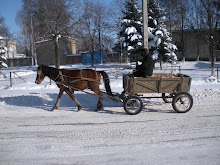
First Snow at "Progres"


Radio Baba

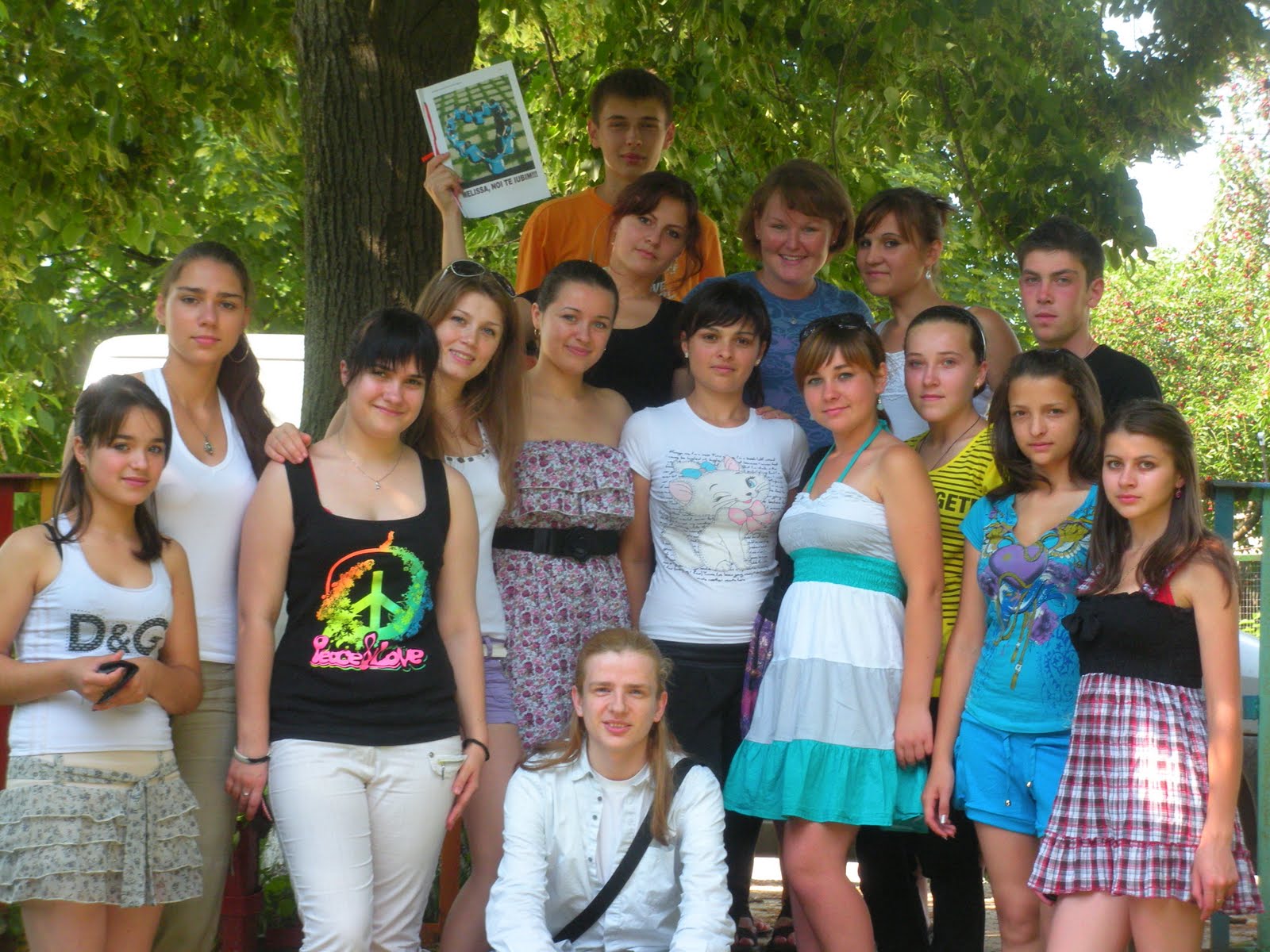
I honestly thought “radio baba” was a joke among Peace Corps Volunteers. I had no idea Moldovans were the ones that let us in on it! The box that my friend is modeling so well is meant to hold all the youth council’s gossip, bad jokes, and hilarious memories. For the record, there are two others as well, one for Christmas wishes, and one for small greeting cards for fellow volunteers at the council. The contents of the three boxes will be revealed at the New Year’s party next week.

Radio baba is the most effective means of communication one has ever encountered that is no more technologically advanced than a touch tone telephone. Basically, let one baba know what you’re up to, and legend has it your whole town can know by the day’s end. In the training village, we witnesses this each morning as the babas delivered their goats to the field and proceeded to share their latest. Eat your heart out Twitter.

Winter culture note: Carpet cleaning

I never thought I would write a blog post about carpet cleaning, but believe me I have just witnessed (and participated in) my third method of carpet cleaning since I arrived in Moldova. I am here to say, this last method is bar far the most effective, and not just because it’s fun.
Last Saturday we stripped out floors bear when my host mom announced “spălăm covor în zăpadă!” (“We are washing carpets in the snow!”).

In the picture you can see, much like one of those really long saws used to cut down large trees, two people wield the carpet back and forth, pushing it deeper in the snow. I would not lie ladies and gentlemen… this was effective, as told by the stains left in the snow.
The second step in the process is the typical beating, followed by a day in the afternoon sun. I dare say those carpets took a better bath than me this week!

Winter culture note: Heating

I rather over looked this point of interest until I dropped the word “soba” on a phone call home and found the receiver quite confused. Most Moldovan homes, though not all and certainly not the apartments, are heated by a soba.

They all pretty much look the same, a little different than your average wood burning stove in the States. Here is the soba from the main corridor in our house. We just lit it for the first time over the weekend (our primary source of heat is gas). We burned wood and various bits of garbage (normal) including papers, old rags, etc. Families who use the soba as the primary source of heat tend to purchase coal if it can be afforded.

This is how the heat is conducted through the house. The adjoining walls (including this one in my bedroom) are tiled, and radiate heat into the room. Usually, the soba is lit once a day, and not stoked once it is finished. It is a lot of work! It took my host mother’s sister about an hour each time she lit the soba. Though no complaints here, I could probably grow an avocado tree in my room at night (well, minus the whole ultraviolet light necessity). Quite toasty indeed.

There is also a legend about the infamous “lejanca.” I have a colleague whose family has a bed built on top of a soba. It is a large, family style bed that has enough room for all. In the winter, many families are all about consolidation. Heating one room for all to sleep in is much more efficient than heating a whole house.

Wednesday, December 16, 2009

Back from Bohemia

Grad school? Not so sure… I am almost certain I actually aspire to be a bike messenger in the city of Prague. I would willingly spend my days peddling the intricate streets, taking in the individual stories of each architectural masterpiece, and noticing new characteristics in the statues every single day. There are, in fact, more statues in this city than any other in Europe. Before literacy (and the need to tax residences), the city actually used these statues in place of naming and numbering streets. This would be the life.

I can’t even begin to discern which of the 200 photographs I took of the Golden City are my favorites, so you can click below to view the full album. Also the little comment box turns on the captions. None of them do the city justice. GO TO PRAGUE!


My experience of Prague was most certainly influenced by my current mailing address. Moldovans and Czechs were both subjects of the Soviet regime, but their experiences and opinions of that era are not exact replicas. Add to this the Czech suppression by Hitler’s thumb, and the half dozen or so other parties over the last several centuries, and you can quickly appreciate the Republic’s current independence. Literally, only in the last three decades has this country been able to [finally] breath!

But the western world, by which I refer to the authors of my high school and college history books, barely even notice the events that took place in Bohemia. For example, only in my preparation for this trip did I learn that Martin Luther was not exactly an original thinker. Jan Hus, a Czech priest began preaching in the Czech language (not Latin) against the Catholic Church a full 100 years before Martin Luther made his stand. He was burned at the stake in Prague’s Old Town Square for his actions. His followers (known as the “Hussites,” and later “Bohemian Estates”) actually started the Thirty Year’s War by throwing two men out a window in Prague Castle in protest against the Catholic regime’s failure to deliver on promises of religious tolerances (both men survived thanks to a rather amenable pile manure).

Now, I realize that may not fascinate all of you, so here is a short list of other things you might appreciate that started in the Czech Republic: the sugar cube, contact lenses, the bullets currently being used in Iraq, Pilsner Urquell (very impressive!), and one of Mozart’s most famous operas (apparently it didn’t impress me too much since I can’t remember which one!). In fact, the building (left) where Mozart debut his opera is actually the only place left in the world where the famous musician played before a public audience.

One of the oldest neighborhoods in the city is the Jewish Quarter. At one time, the city’s entire Jewish population was literally walled into this small area, which is why the old cemetery is so famous. Overcrowding soon took over and only one square block could be dedicated to the dead. So the bodies were literally buried in rows until the wall came down. The stories say they cemetery is as deep as ten graves in some places.

There are many other stories for this area of Prague. Almost every synagogue has a story behind its existence, the stories of Jewish children are displayed in a small museum near the cemetery (remnants of artwork a teacher managed to salvage after the children were taken away), and a statue of Franz Kafka literally guards the main entrance to the neighborhood. But the one story I would like to research more is the role of the Jewish Quarter in Hitler’s master plan. Hitler, according to our tour guide, actually planned to use the neighborhood as a museum to a dead race after his extermination campaign was complete. I want to find out why he would go through the effort to do that, and if anyone knows of some literature on this story, please forward it to me. But, at least we can saw this: He did not succeed.

Irony can add some sweet to the “bitter-sweet” story of Hitler’s presence in Prague. The man really did like Prague, and its classical music. Our tour guide told us the story of the day he ordered his men to remove a statue, of a Jewish composer, from the concert hall roof. These guys had no idea which of the four was the intended victim and decided to guess based on the size of one particular sculpture’s nose structure. The true victim was a Czech composer, Hitler’s all time favorite.

Night life in Prague lives up to its fame, and is popular with ex-pats. For example, chatted with a guy of FILIPINO descent who was born in the UNITED STATES to DUTCH parents and studied at university in LONDON. Though, he lived a good portion of his life in SWITZERLAND, where his kid sister was born. [Mom and Shirley: Doesn’t this remind you of Nadya? The waitress in Brussels with the Italian/Sicilian/Greek/French story!] Or how about the ENGLISH bar tender serving up Jen’s IRISH cider in a MEXICAN restaurant, in the CZECH REPUBLIC. That was actually our best meal of the whole trip… We also met lots of other Americans while we were out; students, soldiers, and tourists alike.

While it was great to catch up with some fellow yanks, I do wish we had a bit more interaction with Czechs while we were there. We simply were just too confined to the English Speaking Tourist Zone [with the exception of the post office, and let’s face it, that’s not all that much of a conversation starter]. In fact, despite that Jen and I learned how to say “thank you” in Czech within our first hour in the city, we probably thanked people in Romanian by accident more often that we attempted to use the Czech. English speakers have it so easy.
This was my first trip with a traveling companion in quite some time and I am grateful that Jen was along. It went something like this: I took control of the map, and Jen kept the key to the hostel. We managed to deck out our passports throughout the bus ride to and from the Golden City: Moldova, Romania, Hungary, Slovakia, Czech Republic, Poland, and Ukraine. And…I think that’s a wrap!