Irinia: "We have an invitation to attend a discrimination seminar in Chisinau."
Cristina: "What's discrimination?"
Melissa: "Discrimination is when you deny someone something because of who they are. In America, we pride ourselves on being diverse and respecting one another. But that wasn't always the case. In an ugly part of our history, we didn't let black people have things that white people used. Now look, we have a black president!"
Marcela: "Oh, ok. Like sometimes that still happens to gypsies."
Melissa: "Yes, but let's call them Roma, not gypsies."
Thirty minutes goes by...
Colea: "Marcela, you are only 14 years-old. You cannot be a trainer at the leadership course because you are too young and no one will listen to you. I will not listen to you."
Marcela: "I may be young, but I am the only graduate of the leadership course on the whole district council! And, besides, I've already taught these topics at other trainings."
Melissa: "Colea, are you discriminating against Marcela because of her age?"
Last fall, a number of my Peace Corps colleagues started asking questions about my youth council. What is a council? How is it different than a volunteer club? Can I come visit? Thus, we developed the following program to both educate Volunteers about the council model and provide a space for an experience exchange between two youth councils and the Peace Corps community.
The Guests
From the Peace Corps community, I first invited another Volunteer working with a Local Youth Council in a neighboring district. She and three of her most active council members came to help us convey the essence of the youth council model. In this picture, the visiting youth council is presenting our President with a medallion and pennant from their city.
Other Peace Corps guests included Volunteers working with civic education curriculum, and those interested possibly starting a youth council in their villages.
Part One: Youth Councils
In the first half of the program, both my youth council and the members of the visiting council discussed their activities. In true contemporary Moldvan fashion, each group presented picture slideshows of their favorite activities. My council also showed a short video, with a Mandy Moore song for a soundtrack that makes you...well....pray for it to end quickly.
As if anticipating the day's second act, I watched as the presentation to Peace Corps guests, about council activities, soon turn into a series of discussions between the two councils about how each group pulled-off their respective activities.
Lastly, my youth council presented their summer leadership course model, the best youth program I have seen in Moldova yet (credit to a previous Volunteer, not me). This is an 8-week course taught by youth, for youth. Each year's graduates are given the chance to be trained as trainers for the next year, making it an incredibly sustainable event. Since the program's initial success via a small grant, the district and city councils continued to fund it annually, no questions asked, no grant applications.
Coffee Break
Almost every Moldovan event comes with a coffee break. Ours was very typical, instant coffee and tea made available with hot water from an electric kettle, cookies, chocolates, and pastries.
Naturally, as the group migrated to coffee break, it settled into three distinct communities: my youth council on the couch, the visiting council at one end of the table, and Peace Corps Volunteers at the other. But, since I happen to work with the best youth around, Victor volunteered to provide a mixer, resulting in the activity shown above, mixing the participants and providing an opportunity to present a united presence via a perfect circle.
Part Two: Experience Exchange
The goal of part two was to generate as many ideas as possible. Additionally, since the Peace Corps guest learned so much from the youth in part one, this was a way for them to give back a little, and provide examples from their own experience in clubs and organizations.
Using a very simple rendition of the Open Space Technology, we brained stormed a list of topics, chose three (recruiting volunteers, maintaining and motivating volunteers, and promoting youth talent), and divided into small groups.I loved watching these small group discussions. Frequently, expressions of intimidation (upon hearing about another's success) turned to curiosity, and finally enthusiasm crossed the faces of those most engaged in the discussions.
After 20 minutes of sharing experiences and ideas, each group reported their notes (which each participant will receive an electronic copy of), and we closed the day with our Local Youth Council secret clap, the one we use to finish every event at our council. Though, I guess that gave away our secret...
About 18 months ago I attended a conference with all the other Peace Corps Volunteers in my program. There was one Volunteer, Becca, who was in the middle of compiling a local fundraising book and looking for a group of volunteers to pass the project on to when she finished her service. Before she left, Becca compiled information from more than a dozen local fundraising activities done by Volunteers (see our Wine Day Bake Sale), including what the activity was, the target group, tips for others, and a short narrative of the experience.
Getting involved in this project was one of the most decisive moments in my service. Another Volunteer and I took over the Romanian translation of the book, which was finished in time for it to be printed for every Peace Corps Volunteer and his/her partner by the In-Service Trainings, in winter 2010. We again distributed it during the Pre-Service Training for new Volunteers, made it available online to all Peace Corps Moldova Volunteers, and distributed printed copies at the same winter In-Service Trainings to Volunteers and Counterparts. Somehow, getting involved in this project meant that the rest of my service I would continue to promote the use of local fundraising throughout my service.
During the summer, I spoke with the new Volunteers in my program about the differences between local fundraising in the United States and Moldova. First of all, it is a completely new concept in a civil society that developed on a grant-to-grant budgetary model. Because it is so new, it takes a lot more publicity. One of the four best-practices we've developed is to "Talk it up!"
We have to tell our community:
Before--what we plan to do and why
During--what we are doing and why
After--what we have done and how the community contributed
The Volunteers that arrived last summer are no longer "new," as they are biting into the absolute flesh of their service right now. Over the last couple months I've spoken with Volunteers and their partners at In-Service Trainings about the best-practice above and the three others we've developed: define the budget, be an accountable team, and be transparent. At these trainings we distributed copies of the fundraising manual in English and Romanian. Very few partners have experience with local fundraising activities, but it would be an interesting project to sift through the records and find out just how many Peace Corps communities have used Penny War competitions to raise money for local schools, since Peace Corps arrived some 19 years ago.
Yesterday, what is soon to be dubbed "Melissa's Roadshow" had its debut with a completely Moldovan audience. I distributed the guide and facilitated a short workshop for university and college students who volunteer at Medicii Lumii, in their human-trafficking prevention program.
But to be completely honest, I'm just the one who ended up compiling the information. The grass-roots work is being done by so many other great volunteers. Check out this piece about an English Education volunteer that can't get her students to stop churning out new fundraising ideas.
For a little to over a year, I've been serving as a board member on a Peace Corps Moldova committee dedicated the issues of human trafficking and migration. Our primary work is to connect resources (which are concentrated in cities) to rural communities (through Peace Corps Volunteers across the country). I had no particular interest in these issues before I came to Moldova, but migration is such common fate for Moldovans that it was hard not to notice.
I work rather closely with a local branch of Medecinus de Monde (Doctors of the World), a French human rights organization. This organization's post in Moldova is a pilot program, the first in the organization's history to occupy itself with the issues of human trafficking. This office offers both assistance to victims, as well as a prevention program. I only work with the prevention staff, chiefly Cristina (pictured below). Cristina's volunteer program was named best in the country, in December 2010--an award they absolutely deserve.
Cristina and I have worked together to promote her organization's youth seminars among Peace Corps Volunteers. Last fall, we hosted a joint event with the Medecinus de Monde volunteers and the youth council in my town. We also held a small open house for Peace Corps Volunteers at her office, in October, where we discovered that more than one volunteer actually lives in a "priority location" for prevention programming. Months later, the seminar featured in this post is a direct result of that meeting.
On Monday, I traveled with Cristina and two of her college-aged volunteers to a village in my district that is denoted as one of the "priority locations." Thanks to the help of Rachel, a fellow PCV in that village, we were able to schedule two simultaneous seminars for ninth grade classes.
Now having seen the Medecinus de Monde seminars several times, I can practically recite the material by heart. First, Cristina helps the students come up with a working definition of human trafficking, followed by activities and discussions related to what trafficking looks like, the steps of trafficking, why people are trafficked, and how to prevent oneself from falling victim to it.
In this picture, Cristina is reviewing a drawing the students made of a trafficking victim. She is pointing out that while the students drew a sad, weak, and female victim (presumably trafficked for prostitution), there is a growing trend in male trafficking. I know this to be true from the reports I've seen, and as Cristina is discussing in this photo, male victims are typically those who go off to work three months at a time in Moscow, Russia and never get paid for their work. These men do not identify themselves as victims, but merely unlucky individuals who took a risk by taking an under-the-table job, and therefore do not often report their experiences to officials.
This class of ninth graders took all of 30 seconds to remind me why I hated junior high school, and I wasn't particularly certain the students would allow us to make progress. I ached for the five female students in the first row as their 15 other male classmates attempted to one up each other in all their ruckus. But I admit, I was too quick to judge. The best moment of my day was made by those who were the most disruptive students of all. At one point, towards the end of the seminar, Cristina recited the phone number of a 24 hotline, based in Chisinau. I wouldn't have guessed that these three boys in the back of the room were paying attention, but as Cristina recited the number a second time, all three boys took out their cell phones, and entered the number.
Recall my trip to Zachariah's village last December. The purpose of my trip was to facilitate a youth experience exchange between Zachariah's youth group and another youth group in a neighboring village, led by PCV Shannon. Both of these volunteers are facilitating youth initiatives according to the Public Achievement curriculum.
The previous attempt to have the event was cancelled due to a blizzard, literally. But this time we pulled it off and had a lot of fun doing it. Big thanks to Zach and Shannon for the invitation!
The Purpose
The goals of a youth experience exchange (Schimb de experienta) are rather simple; to give the youth a chance to share their ideas and intentions, learn from one another's experience, and foster new acquaintances.
On the bus ride from the first village to the village were the event took place, we couldn't help but conclude that this afternoon outing was one of the few "field trips" these kids have been awarded. The distance from one village to the other is just 15 minutes by bus, but as a student group, the practice of visiting another group is not yet venerated like the countless youth exchanges an American student leader might attend during his/her high school career.
Standard Beginning
Shannon's facility was a great place to have our event, and after her director and the mayor of the village said a few introductory words, the director introduced the first activity: Human Bingo.
Up until that moment, as my colleague noted, the scene was so terrifyingly typical of high school students it made us cringe. The two groups took seats on opposing sides of the room, looking at the other group but trying as they might to pretend they have not a care in the world. Lipgloss shimmered off the shy smiles of almost every girl in the room, one boy wore a full suit, and though many of the participants introduced themselves as 18 year-olds, I hardly believed they could be 15.
Project Ambitions
Each of the youth groups is working on a community project. At this point, each group has identified a problem in their community and a potential solution. We wanted to give the youth an opportunity to discuss their projects and improve their solution proposals at the youth exchange.
Representatives from each of the groups gave a short presentation about the problems in their respective communities and their potential solutions. Shannon's group yielded the floor for Zach's group (the guests) to present first. Two of the youth described the problem their village: no place for the youth to congregate in their free time (very common opinion in Moldova). Their solution to this problem is to build a youth park, near the school. The youth showed off their sketch of the proposed park, as well as the results of a survey they did in their school, which speaks to the support they have from their peers in undertaking this initiative.
Shannon's group then spoke about the limited access to food in their school cafeteria, the problem they have chosen to attack. Their proposed solution, to provide a tea service service during class breaks, is having trouble attracting the necessary support.
Teamwork
Since both of the groups are rather new, it seemed only appropriate that our interactive break from project analysis came in the form of a team-building activity. The human knot is a perfect way to do this, with groups who have never done it before, because they will participate in the debrief with sincerity. In order to continue the acquaintance building, we mixed the two groups together for this activity.
One team manage to complete the task of untangling themselves. When I asked the group how they succeeded, the common response was perfectly textbook, "We had to listen to everyone's ideas." (Thanks for playing, tell them what they win Bob!)
I asked the other group, which didn't manage to finish the task, if there was a clear leader in their group. "Yes!" They shouted, "Zach!" Hmmmm....
Project Analysis
Keeping the two groups mixed, but divided equally. We spent the next 20 minutes analyzing the project proposals. We decided to use an activity called "Driving Forces," that I found in a Peace Corps manual. It requires the participants to consider the "positive forces" propelling their project forward, and the "negative forces" pushing back the progress. Both groups needed to hear the truth, that they need support of other partners (school directors, other administrators, parents, etc) in order to succeed.
At the end of the day, two participants said that they learned something new about their project through this activity. Thus, my job was done and I went home a satisfied facilitator.
Diplomas, Pizza, and New Friends
At the end of the event, Shannon's director awarded each of the participants a diploma (very important in Moldovan culture). Though I somehow don't have a picture to prove to you...Shannon created beautiful diplomas complete with a photo of yours truly and the title "Moldovan Youth Facilitator." Shannon is amazing like that.
The Mayor of the town took a moment to speak again, awarding the Peace Corps Volunteers who participated our own diplomas too (pictures in the slideshow, above).
Then it was on to the pizza party, where we observed as the youth took it upon themselves to make sure there were youth from each village sitting at each of the tables. Way to go kids! Job well done!
After seeing how impressed youth from Shannon's group were with the youth from Zach's group, and vise-versa, I am once again convinced that experience exchanges are the way to go in youth development here. It hardly matters if I, an American, go to a group of youth and tell them they can be the change they want to see. If they hear it and see it being done by their neighbors, the youth are much more likely to believe that they can do it too.
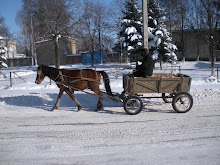
Beautiful shots like this really are a part of winter. Despite the cold, it's almost always post-card perfect during a Moldovan winter.
Work life can be a little more difficult in winter, January is packed with holidays, offices like mine are cold, and because it gets dark so early, we go home much earlier. As such, I made a list of the major projects I'm planning to tackle this winter. I freely encourage your questions as to how they progress.
[+] Children's center programming: In my town, there is a center for children whose families are not able to care for them. The children aren't orphans, per say, because the idea is that after a few months the children can move back home. My sitemate and I are going to spend some time getting to know this center's ins-and-outs. After doing a bit of research on similar centers, my hypothesis is that this center isolates these kids from the rest of the community. After doing some investigating, my sitemate and I are seriously interested in helping them initiate a peer mentor program (think big brothers/big sisters) with other youth in the community.
[+] Defining the role of youth service providers: Another service provider was added to the mix this week. The phone call I received this week went something like this: "Hello, is your name Melissa? I am the new director of the youth center. When can you come show me around the center?"
[+] Spreading youth council goodness: This comes in many parts. Next week, I travel down south to help two volunteers facilitate an "experience exchange" between their two youth groups. For as much as I travel to this southeastern district, I'd say soon the bus drivers and I will be on a pretty solid acquaintance. In January, a few other volunteers are coming to my site to observe our youth council elections. After that, I'll head to another youth group in central Moldova (hopefully with some of my volunteers), to continue spreading the benefits of volunteerism.
[+] Reading good books, drinking hot wine, and and attending lots and lots of holiday parties....
My role in Moldova is changing again. There was the "try to fit in stage," followed by the "now you fit in and try to work with what you are given stage," but now, it's all about delivering change using what I've learned. Bring it on.
To my absolute pleasure, this transition doesn't just affect my work here at site, but more and more I am taking on a consultancy role, helping other PCVs working with youth in Moldova. I am writing the chapters of a book every time I respond to emails from Zach and Cammy. They are both working with brand new youth groups, trying to identify missions, solve community problems, and keep kids motivated. I do not even begin to claim to have all the answers, but it is incredibly rewarding to be able to help them prevent mistakes that I made (or continue to make). Also, as a colleague doing similar work on another topic recently pointed out, I am finally given the avenue for organizing all my thoughts and experiences.
In a sense, this work is also why I was down south last week at Jen's site. Her partner has a group of youth that are too old to be direct beneficiaries of their children's center, but are quite interested in staying involved and developing new skills and understandings. I offer up the session we put together for them as an example of what it is I do in Moldova, it's been a while since I wrote about something other than birthday parties and my awesome host family.
The Afternoon:
1) Evaluation of the group's Halloween party the previous week: What was the best element? What was the weakest element? What will they change if they do it again next year? Since this was one of their first major events...what was it like to work as a team?
2) Team-building activity: The human knot. Moldovans are not afraid of physical contact and have few personal space boundaries when compared with Americans, so it's an easy, and fun activity. What happened during the activity? Did they have to work as a team or could they succeed individually? Which was more important, listening or leading?
3) Building on their interests: The problem tree method (had I not prepared for this the day of, I probably would have chose a more asset-based activity, but I sadly fell for my old stand-by). After making a list of four youth problems in their village, the youth chose to attack teachers' vulgar vocabulary in the classroom.
This is the most original problem I've ever discussed with a group of youth in Moldova. I was thrilled that they didn't chose litter in the street or poverty. Though, I cannot comment on the actual extent of the bad language problem and it should be noted that eventually it was admitted that possibly pupils' behavior is a contributing factor of the vulgar vocabulary. Anyway, moving on...
With the problem tree, we put the problem on the trunk, then address the visible consequences of the problem in the branches. This is the easiest part and usually takes only minutes to complete. Then, we move back to the bottom of the tree and identify the causes, or "roots" of the problem. This takes longer and just like always, the girls in this group were not all in agreement about the cause of the problem.
4) Identifying solutions: Once our tree was developed enough, and the youth were focused again on the causes of the problem, we began to identify possible solutions. This is as far as I was able to lead them during this session, but next time they meet, the director of this center will continue with them to analyze the strengths, weaknesses, opportunities, and threats (SWOT) of their two proposed solutions: A) Writing a letter to the school director and B) Doing a pupil's campaign for good classroom behavior and teacher appreciation activities. I wish them the best of luck and can't wait to hear how it goes!
I'm so proud of the youth council, and my partner in particular. Though it was hard, took three hours, and involved more than one re-vote, we elected a brand new leadership team. And of course, all of that came AFTER our discussion about roles and responsibilities for the president, vice-president, and treasurer. Only after the roles were defined did my partner ask for nominations for each position, and candidates evaluated their own ability to succeed based on the list of responsibilities. They are the best! Furthermore, this year's election was well attended, recognized the development of a few select volunteers over the past year, and re-newed the sense of ownership the youth have over their own representation. Congratulations CLT!
Wooohooo! What a fantastic week, and it's only Tuesday! Okay, so remember the post about my first REAL Peace Corps Project? Or maybe the one about finding a good rhythm despite winter challenges? Or when I gushed about how much I LOVE EASTER in Moldova? Well...I lied, or I exaggerated, because what I meant to say is that this is the part of my service really love. Like really.
Yesterday, amongst the girl talk, vain attempts to extend summer vacation just a little longer, and catch up with work, my partner (right) surprised me--big time. She said to me, "Melissa, I want to have a discussion with the youth council about roles and responsibilities of the president and vice-president before we hold the next council election." Woohooo, again! Granted, it may not seem like much to the average reader, but it took unseen amounts of self-restraint not to bust out a touchdown dance (or did I?). It's small changes like this that I have been encouraging for a year, and now they are being recognized. We are hoping that by defining the roles and responsibilities before people are elected into them, we can have more teeth with which to hold people accountable. After all, you wouldn't apply for a job without knowing what the job was would you?
Yesterday evening was equally enjoyable. As it was my neighbor's birthday we headed over with the rest of the gang to celebrate. "Love thy neighbor" is not something I have to work at here in Moldova, it just comes naturally with this bunch. Since it was also my Granny's birthday back home, several toasts were said for her too. Granny, they wished you good health, many years, many grandchildren, and thanked you for sending me along to Moldova (haha...yea...I know).
Following that fantastic 24 hours was today, and the official closing of our summer leadership course. Here is a photo of the whole group in front of the district council.
Again, this is the incredible program that used the graduates of last year's course as this year's trainers. Very sustainable. Always memorable. This is the first year that the founders of the program were not involved in the planning and facilitation of the events, and as I spoke to the youth today they radiated a certain amount of pride for carrying on the proverbial torch successfully. Irena, a good friend, even commented that this year's group of participants and trainers were much more united as a group than before, being that everyone was learning together. That could be why at about 11:00 a.m. people on the street below probably heard this chant billowing out the third story windows of the district council:
My program exists to build and sustain individual and organizational capacity. My day planner currently tracks the following projects my various partners and I are working on. I hope soon there will be some posts on the progress of these activities!
[+] Drafting formal job descriptions for public employees that work with youth.
[+] Redefining the roles of the youth council's leadership team (i.e. president, vice-president)
[+] Holding an organizational development day for the whole council where we will distinguish between who we are and who we want to be--then come up with a plan to get there.
[+] Teaching adult English classes for three individuals who already spend time in the United States, or are applying to.
[+] Revamping the recruitment strategy for youth volunteers in my community.
[+] Helping organize an awareness event with an NGO in northern Moldova that aims to prevent instances of human-trafficking...we're talking two-hour gig. Live music. Poetry slams. Guest speakers. THE WORKS!
[+] Recruiting other PCVs in northern Moldova to work with this anti-trafficking NGO in their communities.
[+] Working with other PCVs to reboot the Gender Workgroup Peace Corps Moldova.
This week I finally put to use some of the tools we learned last summer that aim to identify and solve problems effectively. I spent two days in a nearby village working with a group of youth that are active in their school's "student council." For the past couple of years, these youth have done countless garbage clean-up days and other one-time events. But now, they are looking to solve some of the bigger issues facing their community. Specifically, we discussed deforestation, ill equipped chemistry labs, and an unsatisfactory gymnasium.
Here you can see the results of one of our first activities--Problem trees. We first wrote the problems we identified on the trunks, followed by the effects of the problem on the leaves. This part was easy, but identifying the "root" causes of problems creates a lot more debate, and requires a lot more time. From this activity we discovered the deforestation in the village is possibly caused by people taking the lumber for keeping their homes warm in winter. The chemistry classes do not actually prepare and observe experiments because equipment is old or missing and a budget for acquiring chemicals was never established. They have no chemicals to create reactions and no beakers because after they were all broken, nobody had money to replace them. It's my understanding that no one in this village, since the fall of the Soviet Union, has learned about chemical reactions from more than just a textbook. Finally, the gymnasium is just something the youth would like to see improved and modernized.
From this activity, we identified possible solutions to the problems and analyzed their validity based on internal strengths and weaknesses, and the external opportunities and threats that may be presented. This method is called SWOT. Some of the solutions the youth came up with were deemed insufficient after doing the SWOT, others deemed reasonable if the external threats could be attended to first.
Clearly, this is why I am here in Moldova. This is what I wish I could do everyday. Build the capacity of others and organizations to solve their own problems without simply stopping at "we are poor." These youth want change, and from what I observed, are far more optimistic about their future than their parents. Sadly, I found the adults in this village among the more despondent. Yet, the ring leader of the group, Mihaela (blue shirt), has a theme for their work: If we want it, we can get it.
Go get it kids...and then get your cherry pickin' on!
Man I missed Moldova. While riding my fourth overnight bus (this one from Bucharest to Chisinau) in two-weeks, I wasn't sure how I felt about coming back to Moldova. But after a good night with friends in the city and some sleep, I couldn't wait to get back to site. The whole routiera ride home was beautiful and green I forced myself to stay awake and watch it all go by.
And look what greeted me at home, an overgrown garden that barely had leaves when I left! Things changed so much I feel like I missed something! Apparently it rained and poured (which I'm glad I missed) the whole time and the plants took off. Check out these sour cherries outside my bedroom window. The ones at the top of the tree are already turning red. The minute they do, I'm busting out the ladder.
My host Mom and I sat in her bed that night catching up on the latest news. Our neighbor became a grandmother a month early, there were two weddings for her to report on, a nephew who needed some medical treatment, a niece who is eight-months pregnant and her husband won't be here for the birth, etc. So. Good. To. Be. Back.
I then learned that I wouldn't be staying home long, as we were headed out to my host-aunt's village for Hram (a celebration every locality has once a year, date is decided by who is the patron saint and the corresponding Orthodox calendar). I love villages, where things are green and quiet. More like home to me. I also love my extended host family. They welcome me to their tables, treat me equally as a guest and family member, and I always sleep comfortably in their homes. This is a photo of my buddy Viorica (who is about to become a big sister!) and her new bike. Me teaching her to ride turned into rather lengthy sessions of me pushing and her relaxing. But she had fun and only fell once. Most energetic little girl in the world.
One last thing I was really excited to find, upon my return, was a two-part series of blog posts by my friend and colleague in the Community Development program. He writes (Part 1 , Part 2) about the central focus of the COD program--its true mission as opposed to the "grant writing = community development" notion that seems to be accepted by many in and around the Peace Corps Volunteer community. I hope you take the time to consider what he writes, particularly if you are one of those invitees headed out way. Drum bun!
Having completed our tour of the district to speak about youth volunteerism, Saturday was the first day of training for our new recruits. Until this point, we had only briefly visited them in their villages to talk about all the benefits volunteerism can bring to a community, now we are actually giving them the skills they need to create and achieve their goals. Of course, no event like this gets started without a name game. This was by far the hardest one I had ever played, you have to listen to your teammates (who are yelling in a number of languages) and try to guess who is sitting behind you...and remember his/her name.
I am thrilled about these trainings because:
[+] We have incredibly active participants/volunteers
[+] Like the summer leadership course that was started by Nadya and Sharon, this is a program where youth are teaching youth...SusTAinABIlitY!
[+] The youth in town already have an arsenal of skills including leadership, teamwork, and public speaking (not that they aren't constantly evolving), but the youth from these villages have many more areas of needs than the youth in my town. Building relationships with them means that I could opening the doors to a lot more work in my district as a whole.
[+] It is my partner's first chance to stand on the instruction side of the line. She is actually so active, some of the other youth trainers asked her to not talk so much!
My job is to build institutional capacity. To make my partner organization more effective and sustainable, that is the task at hand. Time and time again I get beaten down when my ideas aren't taken seriously, or allowed to come to full fruition. Or someone who once appeared to be excited to work with me starts to lose interest (or goes abroad!). Do I take it personally? Chalk it up to cultural differences? Or just move on and work with someone else?
Lately, I've been going with the latter. This is an old photo of Doina (the best 14 year old friend a 23 year old girl could have) and me. Back when I washed my hair three times a week instead of two, maybe I should start that again...
Anyway, on Saturday I spent exactly 90 minutes in my office and built more capacity than I had all week! Doina is responsible for the idea to facilitate youth leadership and volunteerism seminars in the villages, for which we received a grant to carry out from the "Open Society Institute." Monday afternoon we will be holding an open house to tell people in our town about the project and Doina will be giving a short presentation. We decided to create a Powerpoint presentation, a format Doina never had a chance to learn.
For the most productive 90 minutes of my week, Doina and I sat side-by-side, she in front of the center's Russian language-based computer and me in front of my laptop which runs in English and Romanian (when I want too), mimicking each others actions to locate the commands and features in Powerpoint that we needed. Ninety minutes and presto! Presentation complete (check!), skills transfer completed (check!), and lots of laughs in between (check!).
This is my first REAL drop in the bucket towards helping my partner organization become more self-sustaining in the long run—the heart of my work here in Moldova. Unlike the many events I’ve helped the youth with, this was an event the youth had never been exposed to before, and I helped them orchestrate it. Needless to say, I finally feel like I’ve contributed something!
The situation is something like this. The youth want to do lots of great projects (like building a playground and helping surrounding communities build youth centers), but they do not have any sources of income.In a planning discussion with some of the youth leaders, we decided to take advantage of the large amount of people who would be coming in for our town’s wine day and sell something. Raising the money ourselves is far more sustainable than grant writing, plus the money is easier to appreciate when you have to work for it!
So what did they want to sell? It went something like this: “Melissa, do you know how to make those cookies from America with chocolate?” And off we went…
A week before our chocolate chip cookie sale, I taught seven girls how to bake the cookies. Then each boy from the youth center purchased and donated an ingredient to the girls. Each girl was responsible for baking a batch of cookies at home the day before the event. The result of our bake sale, the first-ever for the youth, raised a quarter of a teacher’s monthly salary in just over two hours! Everyone went home happy.
In addition to the monetary gain, here are a few other successes of the event. The youth did a new kind of fundraising, and interacted with people from the whole raion in doing so. They had the opportunity to tell people who they are and what they want to do with the money that will help the community. They educated people about the concept of donating to good causes, and saw that the youth were working for their money. So many people were new to this idea!
We discovered two significant cookie selling strategies at this event. First, the youth had to be energetic. When they danced the hora with customers, and made themselves noticeable, more people came over to see what was going on at our booth.
This gal, Vica, would earn a free trip to summer camp for cookie sales if she only had that little green uniform. She was dancing all over the place to attract customers, taking platefuls around to all the exhibitioners, and had a sales-pitch that only a kid selling newspapers on a soap box could compete with! Way to go Vica!
And, about 40 minutes into our cookie sale, and through a series of discussions unknown to me, I ended up on stage with 500 pairs of eyes staring at me while I explained who I was, why I helped the youth prepare these cookies, and the great plans for the money that we will raise (for the next two days people stopped me on the street to ask how long I’ve studied Romanian. Compliment or criticism???). By the time I made my way back to the booth, I couldn’t actually get through the crowd. We made close to 100 lei in the ten minutes immediately following my little announcement. Overall, the event was a huge learning experience for the youth.
The best way to wrap this up is to quote my partner’s reaction. Mind you, this is a translation. But the last word of the quote is the same in English, just that the “u” is pronounced with something more like an “oo” sound and the “er” is more like the word “air. Try it, it will be more meaningful.
“Melissa, this was a good idea. I was a pessimist this morning, but that was super!”
Thus far, my time in my community offered weeks bloated with activities, followed by weeks starving for activity. However, I think all that is about to change as I make my move to ensure the weeks ahead represent the former.
Last week my partners (two of the youth from the council) and I spent three days at a Peace Corps conference sharing experiences with other volunteers and attending various seminars. Though my words may fail me in my attempt to convey the incredible outcomes of something so plainly called a "conference," you should know that this event had a tremendous influence on my attitude about being in my communiy and working with the people in it. Simply put, I AM ECSTATIC!
I brought so many ideas back from the conference and though my romanian still holds me back a little, the youth are constantly inquiring about my opinion on projects and ideas. I think I've achieved another one of Emerson's measures of success: to gain the affection of children (to laugh often and much is his other measure that I've "managed" to accomplish). Remember people...the little things count too!
So what's in the fire right now for my work? What's keeping me busy? -The youth want to renovate an abandoned lot into a basketball facility. We are exploring the ways to make this as sustainable a facility as possible. I'm looking into this whole recycled shoe conept...but the vice-mayor already granted us the space. A step in the right direction! -Romanian lessons. Now that my teacher has her school schedule set, we are working together four hours a week. That's 20 hours of lessons in total before my next Language Proficiency Interview, in October. -Translating some documents for a youth volunteer who is aplying for a grant. -Going to the center for youth with disabilities. We're going to play sports outside before the last bit of summer fades away! -Attending meetings with various NGOs in Moldova about their work and how working in Moldova is different than working in the United States. -Finishing up the repairs to the center before winter. -Preserving more food for winter (I'm a little concerned about that cheese...foarte interesant! very interesting!) -Planning a celebration for retired teachers.
This weekend I facilitated my first solo activity (though, I am quite grateful for the presence of another English speaker who was able to help her colleagues understand my special brand of Romanian). It was fun to be back on this side of things after having spent the summer as a participant in many training exercises.
The activity is called “community mapping,” and it helps different groups identify different resources in communities. For instance, the group was able to identify a lot of institutions in their community, but soon realized they have actually worked with a few. We conduct these kinds of activities to help facilitate “asset based development” rather than relying on outside funding and resources. Onward!
…this was the message the youth presented to the community over the weekend. Over the course of three days we worked on the last ecological project of the summer (school starts September 1st). After spending only two hours collecting garbage in the park, we came back the next day to the crowded marketplace and literally built a mountain of trash in front of the entrance.
The youth did a great job presenting the activity and its mission. They stopped observers to talk about the problem of garbage in our town. They explained they were holding the demonstration as a way to raise awareness of the problem and hoped they could make people think the next time they threw a plastic water bottle on the ground.
In the few hours we were there, most people thanked the youth council for their work. The local radio station heard about the event and even came down to interview some of the youth. So after hearing about the great programs the youth are already doing, you might be wondering…why do they need Melissa? Well, the majority of my work will be behind the scenes of the organization and the incredibly motivated youth that are there. For instance, this week we are working on a database of the group’s past projects. As of now, there are no written records of the past programs and activities. Having a database that can be continuously updated will help the organization in a variety of ways. Most importantly, when the group is applying for funding, scholarships to seminars and conferences, and other resources. The database will serve as proof of activity. Additionally, we plan to use the database in conjunction with a new visual aid (okay in simple terms…a piece of poster board on the wall with a chart on it) to help members of the council be accountable for his/her programming requirements. Every member is required to participate and manage a certain number of activities (To my res-lifers out there….does this sound familiar?).
These two tools are my first contributions to the organization’s sustainability, but certainly don’t make for very interesting photos and blog posts like fabricating a mountain of garbage and holding a peaceful demonstration.
I served as a Community and Organizational Development Volunteer in the Republic of Moldova from 2009-2011. Please help make this blog a conversation by leaving your comments.